
Congratulations to Dr Marc Weiss, a worthy winner of the ITSF 2025 Timelord award.
From 1979 to 2013 Dr Marc Weiss worked at the National Institute of Standards and Technology (NIST) Time and Frequency Division in Boulder, Colorado, formerly the National Bureau of Standards (NBS). He specialised in time transfer and synchronisation techniques, statistics of clocks and timing systems, algorithms for the time-scale ensembles and relativistic effects on clocks. He retired from NIST as an employee at the end of 2013 and has now been a consultant on precision timing systems since 2014.
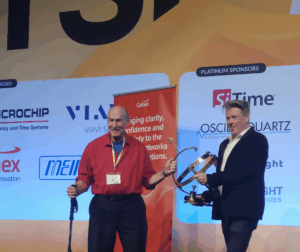 Dr Weiss received several awards from NBS/NIST. In 1983 he received the NBS Applied Research Award for a first GPS timing receiver in 1983 and led the NIST programme to support the GPS programme office in developing their clocks and timing systems from 1980 until his retirement in 2013. Dr Weiss was awarded a patent for the Smart Clock algorithm in 1993, and in 2013 he won the NIST William P Slichter Award, given for major contributions linking NIST with industry. “For pioneering highly productive industry/government partnerships to advance telecommunications and data networks through precision synchronisation.” This award was largely due to the Workshop in Synchronisation and Timing Systems (WSTS) that Marc founded in 1992, and which he has led as an annual event ever since. The Workshop is the largest precision timing conference in North America, and stimulated a European conference, the International Timing & Sync Forum (ITSF), which is the largest timing conference in the world.
In April 2019, Dr Weiss was awarded the Marcel Ecabert Lifetime Achievement Award from the European Frequency and Time Forum (EFTF) and the Societe Francaise des Microtechniques et de Chronometrie. The citation reads: “For his key contributions to remote clock comparisons, to time scale algorithm development and to accurate synchronisation for science and industry.”
Dr Weiss is an expert in timescale algorithms to combine data from several clocks, optimising the ensemble stability to exceed that of individual clocks, and for anomaly detection and mitigation. He has extensive experience designing algorithms and analysing results for the development of the GPS, as well as working with some of the most accurate clocks in the world at NIST. His research interests are in time transfer techniques, the use of GPS and GNSS, statistics of atomic clocks and time transfer systems, time-scale ensembles, and problems of Relativity as they relate to GPS and to primary frequency standards. Recent works has focused on the use of time-scale ensembles across multiple platforms, and Alternative Position, Navigation and Timing (A-PNT) systems that do not depend on GPS or GNSS. Marc has over 100 publications from his time at NIST and his consulting since then.